Training Dino (Wiley) to love the ear trimming process was easy to do with clicker training. It just takes time. I started Dino when he was 2, and practiced every couple of months while I was clipping pony anyway. I got a little more practice after I purchased some handy cordless $12 mustache clippers. I was just too lazy to get out my real clippers and go find an electrical outlet (I know, pretty bad!).
Dino is only 3 in this video, and he is already pretty decent at the ear trimming process. I can trim 1 handed with Dino untied. I prefer him untied, so he feels like he can move away if he is uncomfortable. Dino started out like most horses and wanted nothing to do with clippers inside his ears (or on his bridle path). He was OK with them on the outside of his ears though-but by no means relaxed. I slowly desensitized Dino to the feel of clippers and then to their sound. Only after he was relaxed with the sound and feel, did I try to go inside the ear. Even then, I stopped after the first swipe and gave Dino a nice jackpot reward. Now I can go deep into the ears with no resistance. What a good baby dinosaur!
My “once in a lifetime” horse Tucson passed away back in 2013. So, imagine my surprise when I found out he had been featured in Horse Nation. I love the idea that he is still doing his “demos” for people, even long after he has gone. I hope he is still getting carrots in heaven every time someone watches him jump at liberty! As of today, there are over 30K views….that’s a lot of carrots!
Training a horse to go to its “mark” is super easy. In this video, Wiley has had 4 days of training to target to his mark. He got the idea of this game easily and loves to play it. Since Wiley has a super high play drive, this is a great way to engage his mind while getting some energy out. He gets bored pretty easily, so I constantly have to find new and fun things to train on.
I used a mat for Wiley’s “mark” and started by just leading him up to it. When he put both feet on the mat, I rewarded him. It didn’t take long before he got the idea. Next, I free longed him, gave the command “mark” and removed the driving aids. Wiley came in to the mat. It took Wiley a few attempts to understand that BOTH feet had to be on the mat for the reward, but I just hung out and waited. He eventually figured it out. When he was consistent at going onto the mat, I took him to the other end of the arena and gave the command “mark.” You can see his first attempts on the video below. By the way… the video and the still shot were taken by my little 8 year old man Karsten. He’s getting pretty good!
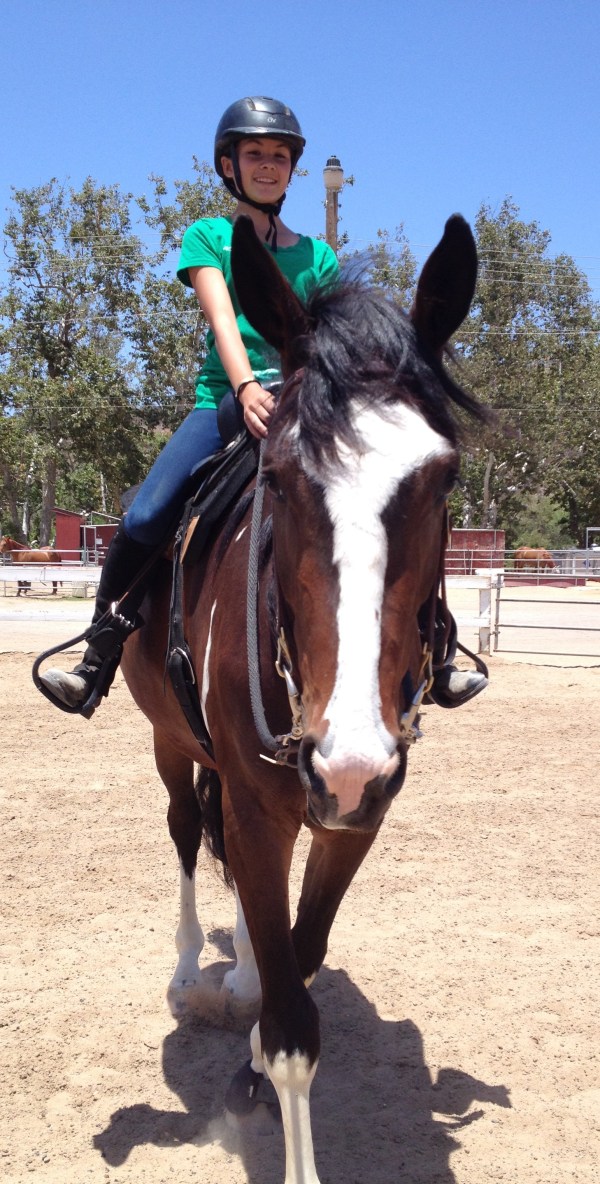
For Wiley’s 16th ever ride under saddle, Kelsey (13) took the reins. Wiley is already 16.3 and Kelsey is just at 5 feet, so they made an interesting pair. I just let them walk around, and Wiley was a perfect gentleman. I was so proud of them both!
Although this was a fun thing to do for Wiley’s Sweet 16 Ride, there really is a reason why I did it. I wanted to start generalizing Wiley’s under saddle training. I don’t want Wiley thinking that I am the only one that can ride him. He needs to learn that it is OK for others to get on him. I start slow, and feather in other riders occasionally. Everyone gives aids a bit differently. Wiley needs to understand that all of that is OK. He passed his first test with flying colors!
Wiley has gotten to the point that if I told a competent rider he was an old, un-tuned lesson horse, they would get on and ride thinking nothing of it. His steering is a bit jerky at the walk and trot. And at the canter, his steering is still a work in progress, but he rides like a kid’s lesson horse. He knows the basic aids, it just takes him a bit of extra time to process them. Wiley’s transitions are decent. He only trots a few steps before the canter. He picks up his correct leads most of the time and he keeps a consistent pace. He can trot serpentines, and he can back, turn on the haunches and forehand relatively decently. He just needs time in the saddle and his response times will get better. I started riding him outside the arena as well. So far, so good, but of course, I am taking it sloooooow!
Wiley has been ridden a total of about 2 hours in his lifetime. In this video, I am beginning the process of transferring some of Wiley’s aids from ground work to under saddle. Wiley is clicker trained, so he is rewarded after each correct effort.
The lateral aids I used on the ground for turn on the forehand and haunches are close to the aids under saddle. With very little ride time, Wiley is already starting to understand these movements. He can delineate between an aid slightly in front of the girth (move the shoulder) from an aid behind the girth (move the haunches). Backing while giving at the poll was just a straight pick up from ground work.
At this point in Wiley’s training, most cues are very light tactile aids. I can use one finger on the reins or a touch of the stirrup for Wiley to understand what I want. Notice on the backing aids, however, that Wiley makes a big “give” while backing. That is not from pressure. That is from his training to give while backing. He is just making a big effort here. Wiley can back with one finger on the reins. The one thing Wiley isn’t very good at yet is turning while moving forward. He is just learning to control his body. For now, sometimes he over turns, and sometimes he under turns. Sometimes he doesn’t turn at all and sometimes his body doesn’t follow his nose, and he pops a shoulder out. Since I am not yet using leg aids to control his body while riding (I am working on getting the forward cues solid), I use a dressage whip to touch his shoulder and remind him to keep it in line. Works perfectly. The turning thing just takes time for him to understand just how much turn I want. It will come with experience.
Wiley is also learning to canter. This video is of his third time ever cantering under saddle. Although you can’t hear it because of wind noise, I am using a verbal canter cue to help Wiley understand what I want. When he first transitions to the canter, I reward him so he knows he is doing the right thing. The second time I ask, I let him canter a few circles before the reward. Even though his canter is very smooth and rhythmic, I can tell he is still very unsure of himself. I will keep his catnering very short until he gains confidence and balance.


 Del Mar Horse Girl