Wiley has been ridden a total of about 2 hours in his lifetime. In this video, I am beginning the process of transferring some of Wiley’s aids from ground work to under saddle. Wiley is clicker trained, so he is rewarded after each correct effort.
The lateral aids I used on the ground for turn on the forehand and haunches are close to the aids under saddle. With very little ride time, Wiley is already starting to understand these movements. He can delineate between an aid slightly in front of the girth (move the shoulder) from an aid behind the girth (move the haunches). Backing while giving at the poll was just a straight pick up from ground work.
At this point in Wiley’s training, most cues are very light tactile aids. I can use one finger on the reins or a touch of the stirrup for Wiley to understand what I want. Notice on the backing aids, however, that Wiley makes a big “give” while backing. That is not from pressure. That is from his training to give while backing. He is just making a big effort here. Wiley can back with one finger on the reins. The one thing Wiley isn’t very good at yet is turning while moving forward. He is just learning to control his body. For now, sometimes he over turns, and sometimes he under turns. Sometimes he doesn’t turn at all and sometimes his body doesn’t follow his nose, and he pops a shoulder out. Since I am not yet using leg aids to control his body while riding (I am working on getting the forward cues solid), I use a dressage whip to touch his shoulder and remind him to keep it in line. Works perfectly. The turning thing just takes time for him to understand just how much turn I want. It will come with experience.
Wiley is also learning to canter. This video is of his third time ever cantering under saddle. Although you can’t hear it because of wind noise, I am using a verbal canter cue to help Wiley understand what I want. When he first transitions to the canter, I reward him so he knows he is doing the right thing. The second time I ask, I let him canter a few circles before the reward. Even though his canter is very smooth and rhythmic, I can tell he is still very unsure of himself. I will keep his catnering very short until he gains confidence and balance.
Wiley is growing up fast! With a few trotting rides under his belt, it was time to try canter.
Just like when I first asked Wiley to trot under saddle, Wiley was put on the longe line. This way Wiley can focus on 1 variable of change-carrying a rider under saddle. He doesn’t have to think about too much. I am in the middle giving cues and supporting him the whole time. Once again I chose Amy for the first canter ride because she is a quiet rider that won’t lock up if Wiley should pull a baby horse stunt.
Of course Wiley has no clue about canter aids under saddle, so Amy’s aids are only a pre-cue. Wiley is taking his commands from me. I just like him to get used to the idea of the under saddle aids. Eventually, he will start cantering off the pre-cue alone. Amy will only use her legs for transition to the canter and then take them off completely (no steering with them…that comes later). Her only steering is through the reins.
When Wiley first transitions into the canter, I click him after only 2-3 strides. This lets him know that the transition was correct. It also gives him a reward before he thinks too much about what is going on. After rewarding him for the transition twice, I go ahead and let him canter a full circle or so before a reward. In his 4th canter transition under saddle, I let him canter 3 full circles before giving him a jackpot reward and ended it there. That is plenty for Wiley to think about day 1.
Baby dinosaur’s big “Under Saddle” adventures are just beginning. Wiley is not quite 3, but I go so slow, that he will actually be 3 by the time he is ridden for more than a couple of minutes. I just couldn’t wait. As of today, Wiley has 4 rides under his belt. He is proving to be a pretty good little dinosaur. My entire goal is to keep each ride under the stress threshold, so Wiley is relaxed enough to do some good learning. Here’s how they went:
Ride 1: I just planned on refreshing Wiley’s memory on mounting and let him walk a bit. Unfortunately, it didn’t go as planned. He was fine as I mounted, and we walked around. But then, someone’s horse got loose and it ran right by the arena, dragging its lead rope behind him. Oops. Not a good way to stay under the “stress threshold.” Wiley spooked, turned and faced the horse, but that was it. He didn’t run, jump or do any dumb baby horse stuff. How great is that? Of course he had his head up in full giraffe mode. I rubbed his neck and gave him the “head down” command. He just stood quietly. I was so proud of him. He was a bit nervous after that and no good learning was going to take place, so we walked a bit and I rewarded him. Then I got off while on a good note. Not exactly the way I wanted to start him.
Ride 2: My plan was just to repeat Ride 1 but with a relaxed horse. All went well. Wiley was good. Starting to move forward off my leg and doing a bit of turning.
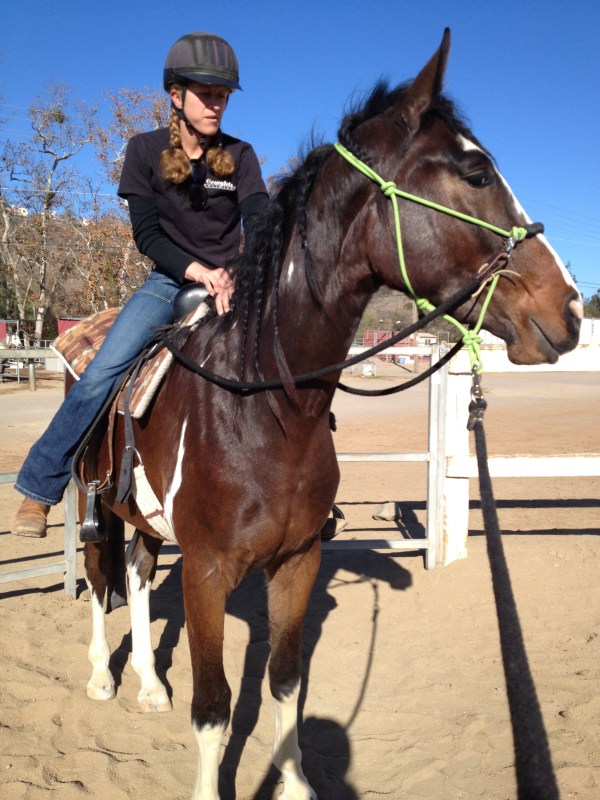
Ride 3: I finally remembered to bring a clicker for this ride, to reinforce the “walk on” leg command. Worked like a charm. Wiley was walking off a tactile leg cue only (no pressure needed). We walked in figure 8’s, backed a few steps and stopped to chat with a friend. Wiley was so relaxed, you would have thought he was an old trail horse. He just stood quietly while I chatted. No fussing whatsoever. I am starting to really LOVE this horse! The picture below is immediately following this ride. What you are seeing is pure relaxation. He worked for all of about 5 minutes entirely at the walk, so he isn’t tired, and he didn’t have to pee. He was just THAT relaxed (this is normal behavior for a clicker trained gelding . They are so relaxed, they almost look drugged). I just got off, tossed the reins over the fence and took the picture. This is the “look” I want to see before moving on to the next lesson.
Wiley’s 3rd ride. Clicker training for the walk transition. 5 minutes of work and Wiley is TOTALLY relaxed!
Ride 4: Today is trot day. I like to start the trotting (or cantering) part really slowly. This is where “stuff” can happen. The added speed can sometimes stress a horse. I tacked Wiley up and put him on the lunge line. After a quick warm up, it was time to bring in my friend Amy. Amy has a great seat, and I trust she won’t lock up on Wiley if he should get nervous. Since Wiley is well trained on the lunge, the only added variable will be a rider on his back. He doesn’t have to think about much except carrying some extra weight. Amy used a tactile leg cue to ask Wiley to walk. I supported her with the lunge whip. Trotting went the same way. Amy pre-cued with a tactile leg aid and a voice command. Then, I supported her aids, by bringing the whip up to horizontal position (Wiley’s cue to trot). He trotted immediately. I clicked as soon as he transitioned. I gave Wiley a reward and repeated the process. After a few transitions, I waited longer before the click, eventually having Wiley trot the entire 20 meter circle. Wiley was perfect. No fuss. His body was relaxed. Most people would never know it was Wiley’s first ever trot under saddle. But I could tell Wiley’s mind was “processing” the lesson because he wanted to chew on the bit and reins when we were done. This is how he shows his mild anxiety. We will stay with this lesson until Wiley has fully processed it, and I start to get the “look.” It could take awhile, but Wiley will let me know when he is ready to move on.
Today is the day. I didn’t wake up thinking I’d back Wiley for the first time today, but all the planets aligned. I knew he was ready from a training standpoint. Plus, it was a warm 70 degree day right smack in the middle of winter (gotta love Southern California). Wiley had a couple of really big turnouts during the previous week, so I was confident he wouldn’t be overly excitable. And, most importantly, I had a friend with excellent riding skills that wanted to assist. When a day like this comes along, you just have to go for it!
Special Note: Wiley is only 2 1/2, so I am not planning on really riding him. Because Wiley is already so large, I am going to get him used to a rider on his back before he gets to full dinosaur size. I will putz around on him a few times and then stay off him until he is 3.
Getting Ready for the Big Day
A bit of prep work needs to happen to make sure day 1 in the saddle is as stress free as possible. Wiley has lunged lightly in the saddle a few times with no reaction. I have also worked with him a few days prior to make sure that mounting up would go smoothly. All the steps I went over with him are shown below. There is nothing earth shattering here. All of this is pretty basic stuff.
Horse’s First Day Under Saddle: Step 1
After a brief lunging session, I pulled down on the stirrup with my hand to get Wiley used to the feel of weight being put in the stirrup. I rewarded Wiley for standing quietly. I did this a few times to make sure he was good and relaxed. (Note: all the pictures actually show Amy demonstrating how I performed each step. I practiced steps 1-5 with Wiley before this day as part of the prep. All of these photos were taken the day Wiley walked with a rider on his back for the first time. When backing a horse for the first time, it is great if you have a friend to help you, but it can also be done without help. Amy is an excellent rider, so I know she will stay relaxed even if Wiley doesn’t. I stayed on the ground to handle (and comfort if needed) Wiley as he goes through this part of training.
Pulling down on the stirrup.
Horse’s First Day Under Saddle: Step 2
After Wiley was thoroughly bored with pulling on the stirrup, I began to put my foot in the stirrup (as Amy is doing here). I made sure my toe made contact with his belly and moved it around a bit to get Wiley used to the feeling. Let’s face it, you are going to end up bumping your toe on your horse’s side while mounting sooner or later….might as well get that over with before you do it accidentally!
Putting the toe in the stirrup and letting Wiley feel it on his belly.
Horse’s First Day Under Saddle: Step 3
Wiley is good with the foot in the stirrup, so it is time to start bouncing up and down a bit. After each bounce session, Wiley is rewarded for standing still. Wiley needs to see the movement and feel the tug on the saddle to get comfortable.
Bouncing in the stirrups.
Horse’s First Day Under Saddle: Step 4
Time to stand in the stirrup. Wiley takes a good look back, but doesn’t offer to move. Good boy!
Standing in the stirrups.
Horse’s First Day Under Saddle: Step 5
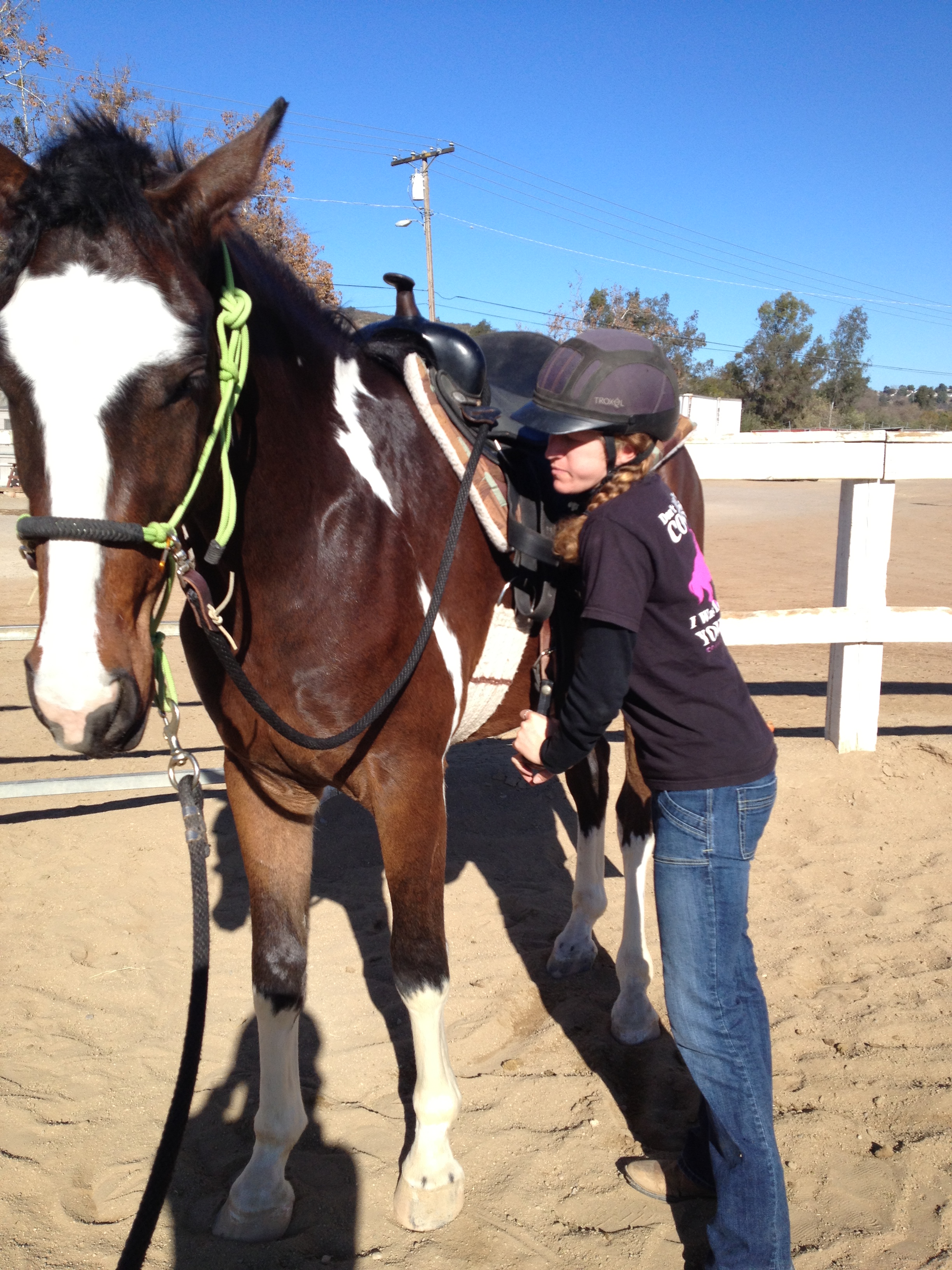
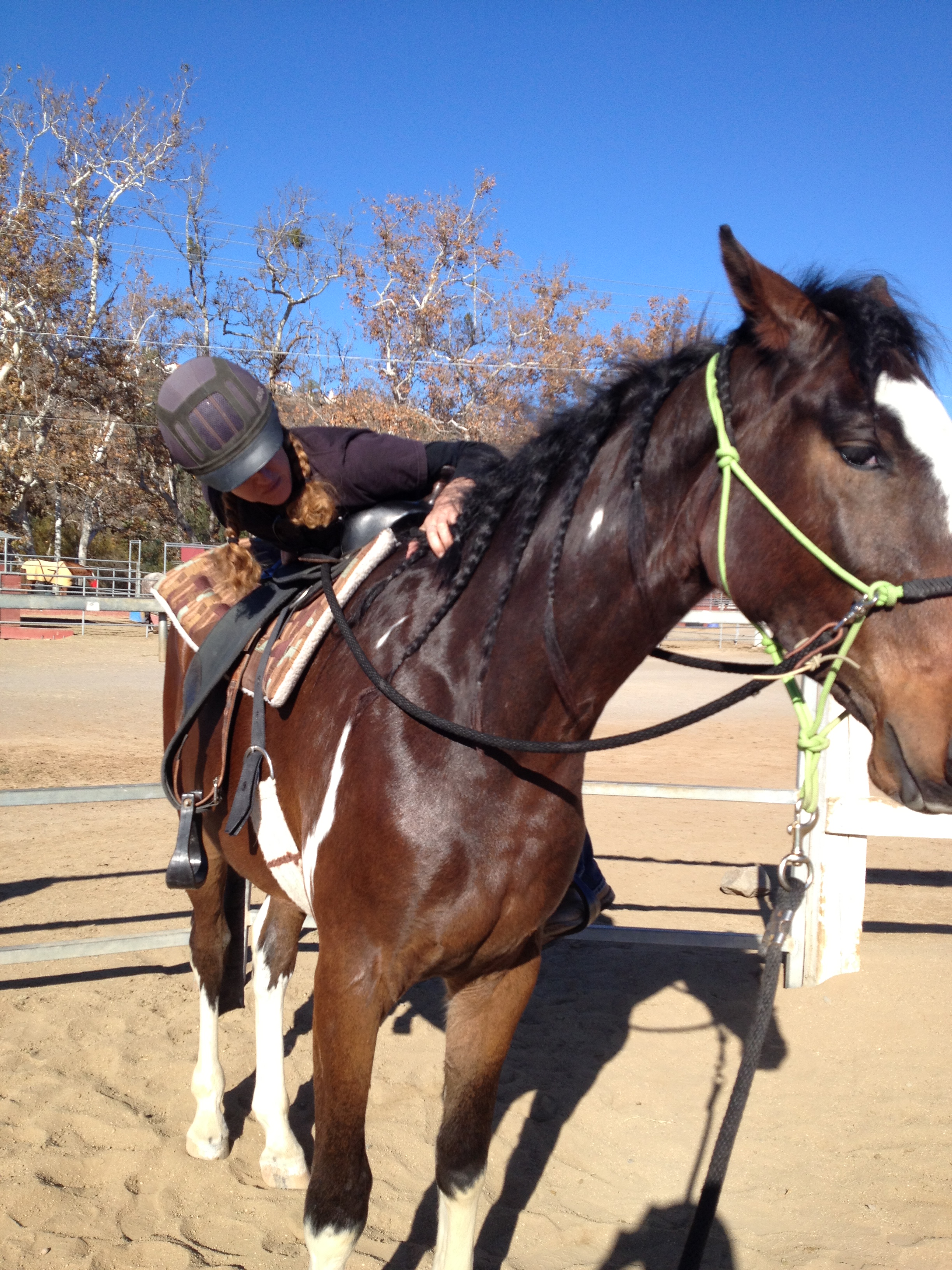
Time to put the belly on the saddle. Sometimes the horse can get nervous when he sees you cross over the middle, and Wiley did give it a good look the first time I put my belly on him. He didn’t try to move away though. I slowly started petting him on his shoulder and hind end to get him used to movement and the feeling of being touched while on him.
Amy with her belly on Wiley.
These 5 steps were repeated for a few days until Wiley was completely comfortable. I performed them on both sides, so Wiley can be mounted from either side. Now he is ready for the big day. Just because Wiley is comfortable with me performing the steps above, doesn’t always mean it carries over to another person. Horses don’t always generalize well, so Amy repeated all the steps above (and that’s how I got pix!).
Horse’s First Day Under Saddle: Step 6
Finally time to get all the way on! Amy does this slowly but with confidence, making sure she doesn’t bump him on his rump while putting her leg over. At first, Amy maintains a low profile as she is doing here.
Staying low while giving Wiley a comforting pet.
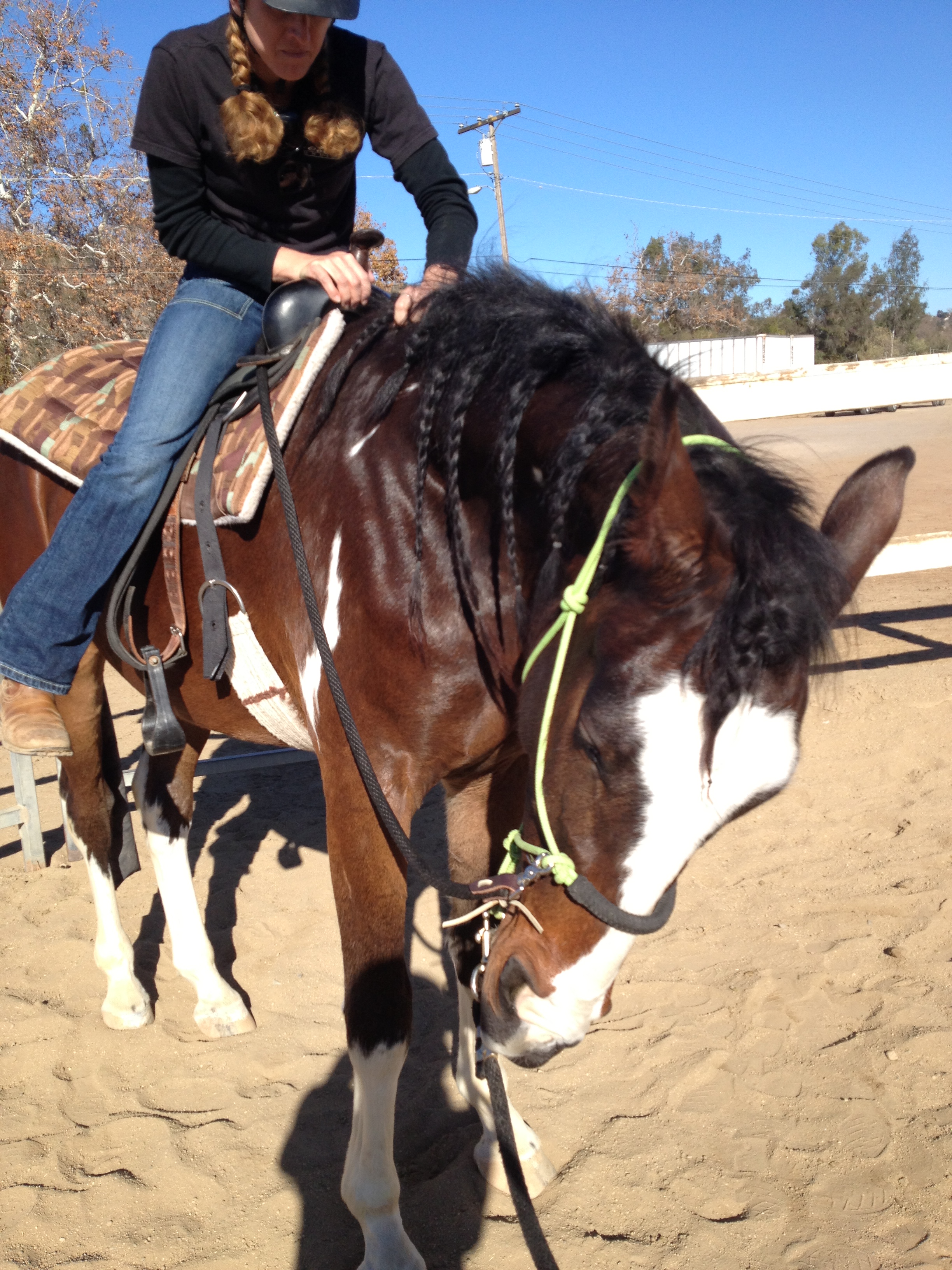
But soon, Amy can sit up and pet Wiley. He even stops paying attention to her- a sure sign he is ready for the next step.
Wiley is showing signs he is ready to move on.
Horse’s First Day Under Saddle: Step 7
Time to move the feet. This is sometimes a strange feeling for a horse. Wiley doesn’t seem overly bothered by it…although he is going to keep an eye on Amy just in case.
Wiley was just a bit tentative at first, but it wasn’t because of the rider. Wiley was trying to figure out what I wanted him to do, so he started offering up an alternative…the maneuver we worked on yesterday seemed to be a good choice. Check out the video below for his first steps under saddle. See if you can guess what we worked on the day before.
As always, when training Wiley to do something new, the session is really short. I know Amy is going to get off Wiley’s back in a few minutes, but Wiley doesn’t know that! The session needs to be short enough that Wiley doesn’t decide it is his job to get Amy off his back. Wiley gives Amy a short pony ride and then he is done for the day. What a good boy!






 Del Mar Horse Girl