There is more to a barn than just horses. All types of wild animals call the barn home. Over the years, I’ve made a few wild friends. My current barn is located on a city park/preserve…which is a fancy way of saying that even the most obnoxious barn critters cannot be touched (no squirrelinaters welcome here). At first all the critters drove me a bit insane. But now, I am starting to make peace with a few of them. Below are some of my all time favorites:
Spot
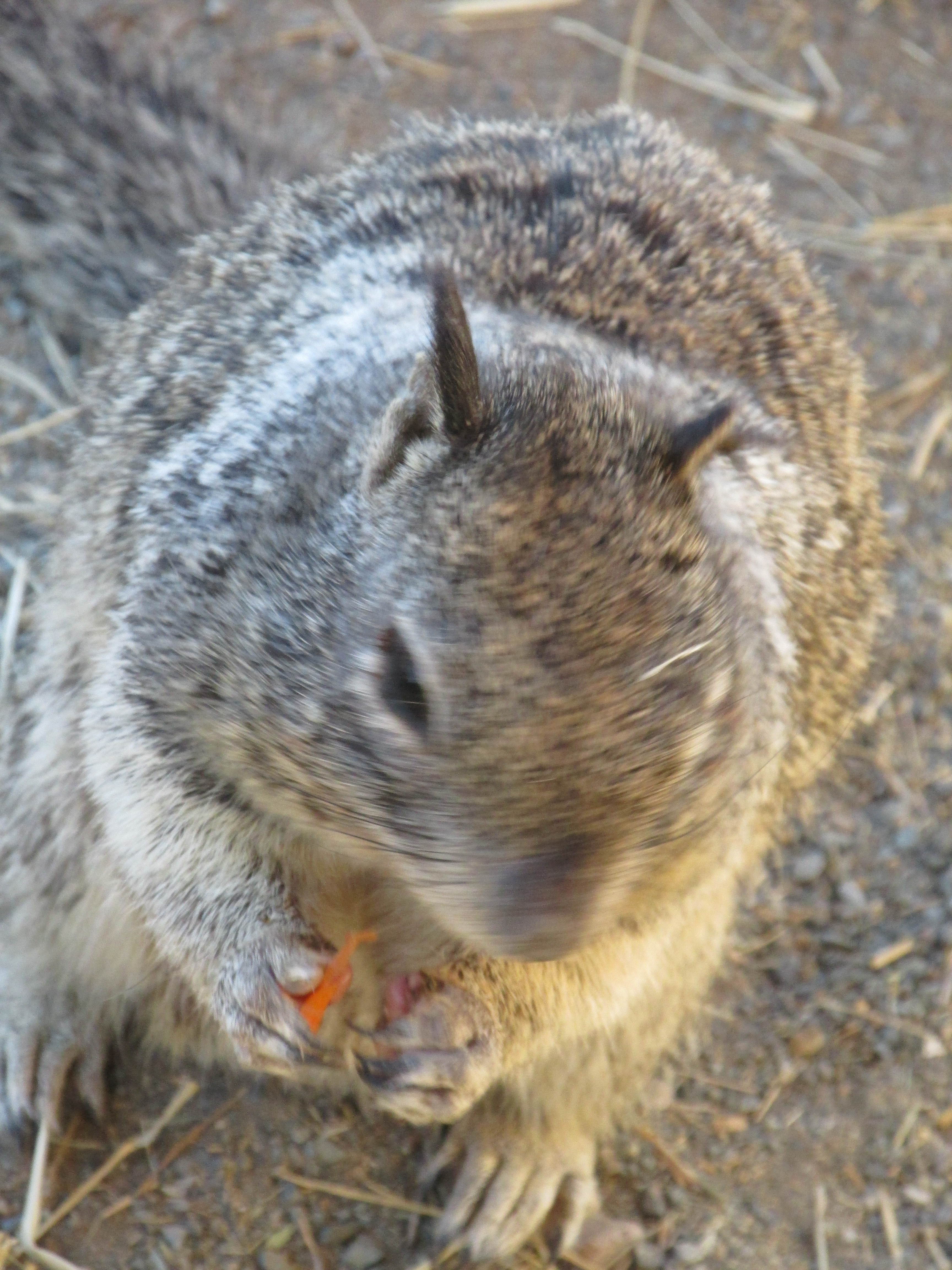
Most of you are familiar with Spot (RIP my rodent friend). Spot is your typical barn squirrel that I decided to target train. Just as soon as he started eating from my hand, he met his untimely fate. I have befriended another squirrel named Holey Guacamole for the perfect hole in his left ear, but I am not motivated to spend the time to train him to eat from my hand. He will target the end of my whip for a piece of carrot though.
Spot
Chop Stix
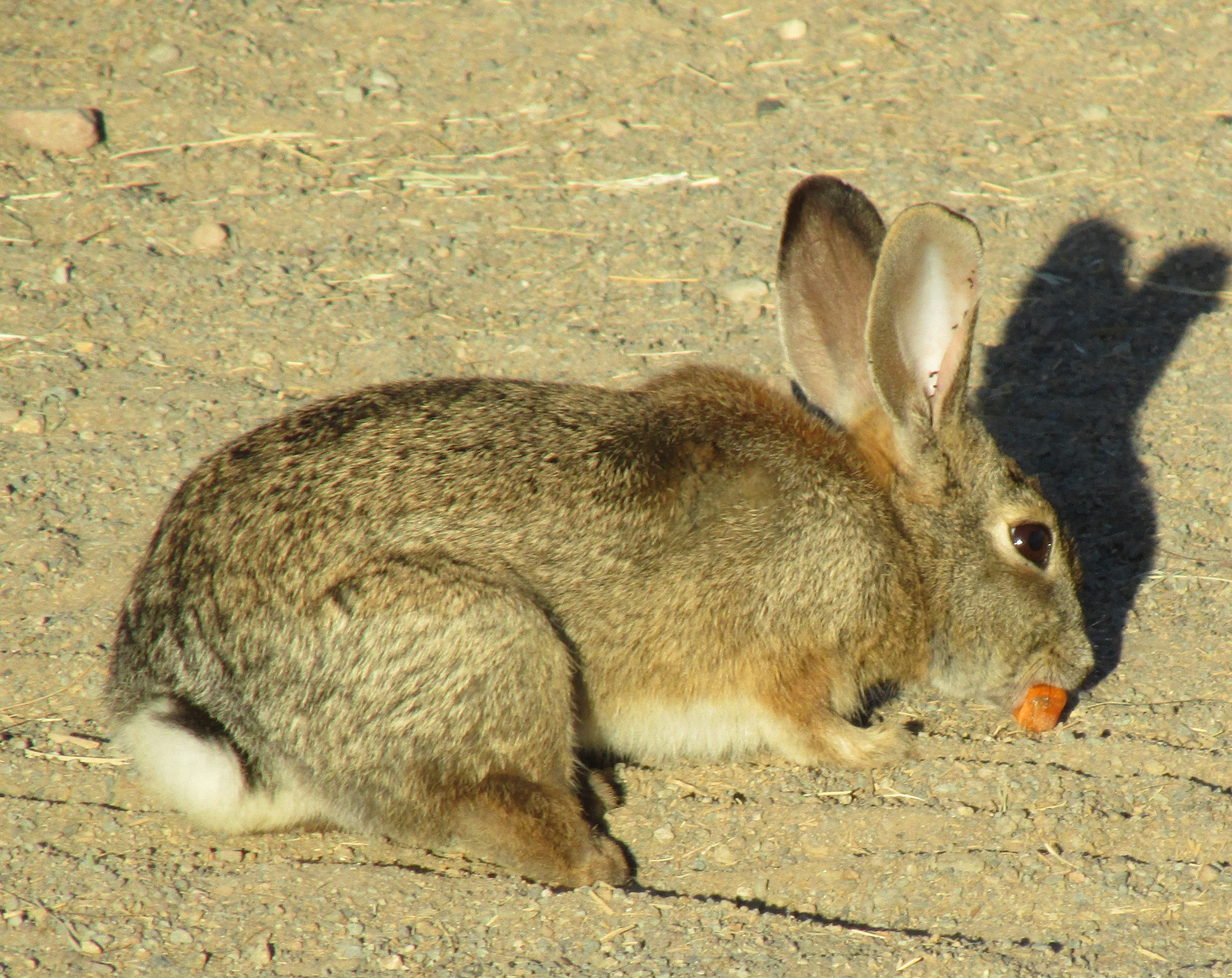
Chop Stix is my all time favorite! She is a wild bunny born in the Spring of 2013. She has a broken hind leg, but that doesn’t slow her down. Bunnies cover a bigger territory than squirrels, so training is tough, but Chop Stix will come out at the sound of my voice when she is in the area. She will stay close and eat the carrots on the ground around me. I am happy to say that Chop Stix found herself a nice boyfriend bunny and is bringing along some baby Chop Stix. She disappears for a bit and will reappear when the babies are older. That is, if Bobbi doesn’t find her first.
Chop Stix (with a broken back leg)
Bobbi
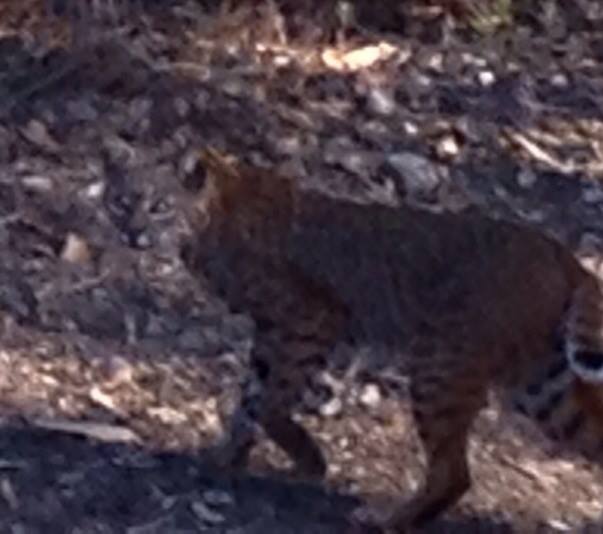
Bobbi is the best friend a barn located on a preserve can have. He and his friends keep the rodent population in check. He is also beautiful to look at. This picture of Bobbi was snapped right behind my tack room. We surprised each other. Thankfully I had my cell with me and was able to slowly pull it out while Bobbi gave me a good look.
Bobbi
Speedy
Not sure what this guy was doing at the barn. I also found him in front of my tack room one morning. I returned him to the nearby creek where I am sure he is much happier.
Speedy
Bandit
OK I found him at a different barn, but he is pretty cool! I’ve lived in CA pretty much my entire life and couldn’t ID this guy as a California Weasel. I thought he was an escaped pet and tried to lure him over with a treat. The funny thing is that he actually came quite close to me. He would advance and retreat, completely unsure of what I wanted. I had no idea this thing was a meat eater and another great companion to have at a barn. This guy can really keep the rodent population in check!
It’s always fun to look up the ancestry of your horse. And, let’s just say I hope Wiley’s isn’t providing a hint to his future. Oh sure it was full of cool stuff like tracing him back to the Godolphin and Darley Arabians. And, Wiley’s sire line is full of historic UK thoroughbreds like Hambletonian (the racer not the trotter), Eclipse (the 1700’s undefeated Tbred). But it is the lesser known names that concern me. In the 1700s, horse names tended to be very descriptive. There are a lot of names like Darcy’s Yellow Turk, Darcy’s White Turk and even Miss Darcy’s Pet Mare. So imagine my surprise when I discovered names like Clumsey, Clubfoot, SoreHeels, and Sister to SoreHeels throughout Wiley’s dam side. My personal favorite name, however, goes to Sister of Country Wench. I am hoping that this is a preservation of 1700’s humor and not a hint at what kind of quality they were breeding back in the day!
I usually dislike rodents at the barn, but I got to thinking….Could I train a wild squirrel to be friendly? I wanted a squirrel to enjoy hanging out with me….maybe even be able to pet it. The only problem with that scenario is that I am secretly scared of touching the little guys. No problem. I found a squirrel willing to work around my phobia.
Meet Spot. Spot is easily recognizable by the large patch of fur that was missing from his back, his torn left ear and the orange snaggle tooth that sometimes protrudes out of the right side of his mouth. He’s a real looker.
Spot was easily target trained to the end of my whip. When Spot hears my voice, he comes out. He sits next to my whip waiting for a carrot. He is so comfortable around me that he hangs out while he eats. He lets me pet him with the whip. I scratch him around the ears and stroke his back. He seems to enjoy the attention. He could easily run off and eat his carrot, but he sticks around until he is done. He waits patiently for the next carrot. He will stay around for quite awhile, leaving occasionally to chase off an interloping squirrel. But then, he comes right back to my whip.
The only challenge with having a squirrel friend, is that they are pretty sneaky. Sometimes while sitting in the tack room, I turn around and find Spot has been sitting quietly behind me the entire time. He scares the crud out of me! Oh well. I will enjoy his company while I can. Squirrels don’t last long around here.
Although I can’t ride Wiley and develop his body, I can do a lot of work developing his mind! Lately I’ve been working on the Spanish Walk. Every new trick he learns helps teach him how to learn. He is starting to actively listen/look/feel for commands. He is getting easier and easier to train. He is still a giant goofball horse and definitely has a dose of 2 year old ADD, but he loves to learn. He gets so excited when I start teaching him things. He follows me around like a giant puppy. I just have to take into account his short attention span, but he is getting better every day.
Training the Spanish Walk
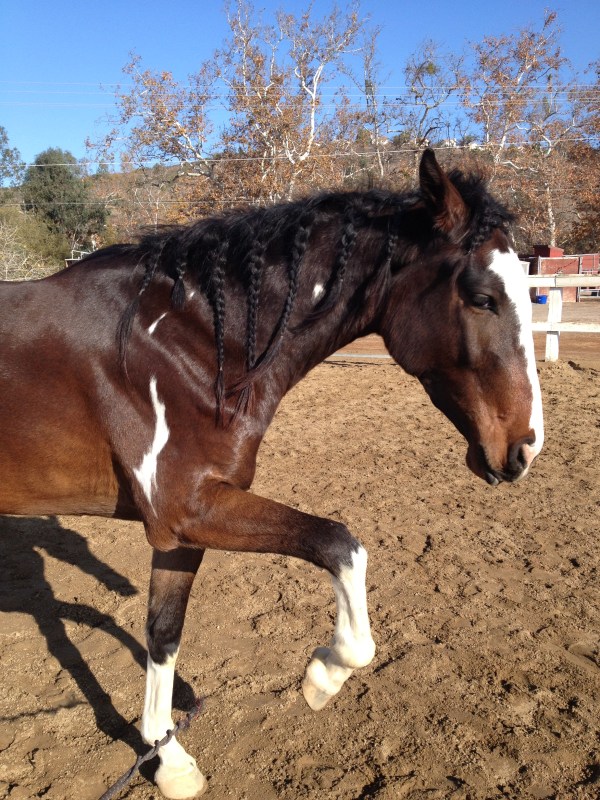
The Spanish Walk is a pretty simple movement for a horse to learn. I like to start training this movement at liberty so the horse always has the choice to play along or go do something else. Nothing is forced. I keep training sessions short and try to end each session before the horse gets bored. It leaves them wanting more. Here’s Wiley learning the movement. Sorry the images aren’t great. It is a bit tough to cue Wiley, and hold a camera and click at the right time…but I am getting the hang of it.
Train Horse to Spanish Walk: Step 1
While standing on Wiley’s side, I give the command “Lift” and use a long whip (driving whip is best but anything will do) and start to tickle his lower leg. You can also tap.
I kept tickling or tapping until Wiley moved his leg to stop the tickle. As soon as he picked up his foot, I rewarded him. Any movement is OK at first. I just want Wiley to get the idea that the tickle or tap does not go away until the leg moves.
Wiley is being tickled until he lifts his leg.
Train Horse to Spanish Walk: Step 2
Once Wiley, could reliably lift his front left with a verbal “lift” and a tickle of the whip, I asked for the right front. I didn’t change my position, however. I just reached the whip farther over to the right leg. Once Wiley could lift his front right, I alternated between the legs, but Wiley remained in the same spot. He just picked up whichever leg I cued.
Wiley on some of his first lift attempts.
Train Horse to Spanish Walk: Step 3
Now for the (sometimes) tough part. Getting a horse to move forward AND lift their legs. Some horses, like Wiley, get this pretty easily. Some horses seem to take forever to coordinate their back feet with their front feet. They start walking their front feet and their back feet stay stationary. They end up looking like a super parked out Morgan! Don’t worry if your horse is on the slow side of learning this movement. Stick with it. It will come.
I asked Wiley to “walk on” and then ask for the “lift.” At first you may have to touch each leg to help your horse understand, but later on, just putting the whip out in front with the verbal “lift” is enough. In the clip below, Wiley is easily coordinating his front feet with his back and getting pretty consistent with lifting his legs.
Train Horse to Spanish Walk: Step 4
Notice I haven’t yet tried to train expression into Wiley’s Spanish Walk. I like to wait until a horse is comfortable coordinating their feet to train in the bigger expression. Below, I am beginning to shape Wiley’s walk to offer more expression.
This Spanish Walk shows more expression.
Train Horse to Spanish Walk While Ground Driving
Once the Spanish walk is confirmed, you can add it to your horse’s ground driving and under saddle repertoire. Since Wiley isn’t saddle broke, I am just adding it to his ground driving.
To get a Spanish Walk while ground driving, I need to change the aids a bit. This is where the verbal cue “lift” comes in handy. It will help Wiley understand the new aids. While Wiley is walking on the long lines (but lunging in a small circle) I give the command “lift” and then add the new aids – squeeze my left rein and then right rein in coordination with the leg that I want him to lift. If he needs more information, I will tap his left leg with the whip. When he takes a few Spanish Walk Steps, I reward him. My goal is to phase out the use of the whip as an aid. When that is complete, I simple get Wiley walking and say “lift.” I then alternate squeezing the left rein for the left leg and then the right rein for the right leg. It doesn’t take too long before you can get a horse to take a few steps as Wiley is doing below:
Learning the Spanish Walk on long lines.
Why Teach a Horse the Spanish Walk?
This is one of those “tricks” that is really useful later on in dressage training. If your horse is not very forward, like Wiley, you can use the Spanish Walk to train a stress free passage. You can also use it on any horse to get a more expressive passage and to have more control over the cadence. If you are ever at a dressage show, stand by the warm up ring and listen to the breathing of the horses while performing the passage. You will easily detect those that are stressed out while performing the maneuver by their breathing patterns. What I strive for is a a relaxed partner that clearly understands what I am asking and gives it to me willingly. I will eventually show you how to transfer this over to a passage on Wiley. However, he is just a young pup now, so that will have to wait. Go ahead and sign up to receive blog updates now, so you don’t miss out!
My previous horse Tucson was trained to jump entire courses of up to 8 jumps without a rider. Wiley is going to attempt to learn the same trick. It starts out simple with training the horse to walk over a pole or cavalleti on the command “jump.” In the first video, it is is clear that Wiley is getting the idea behind the command.





 Del Mar Horse Girl