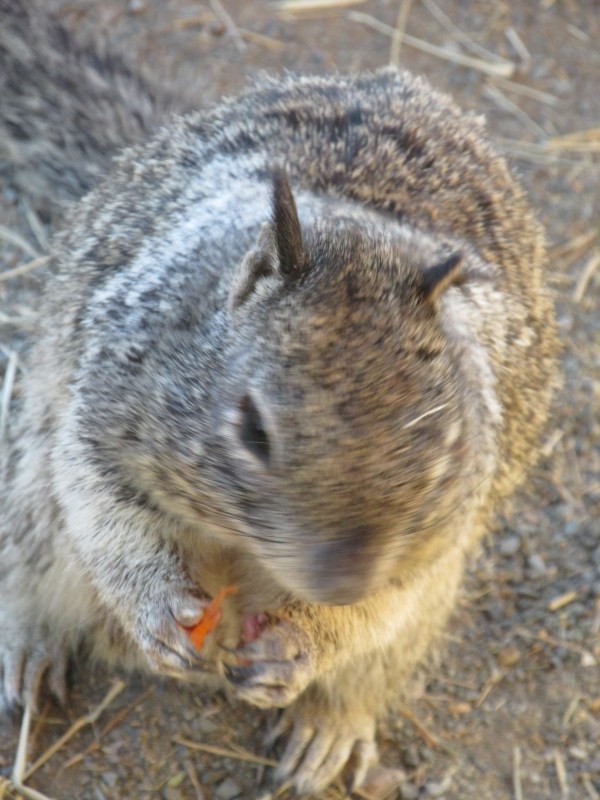
I spent Sunday morning with my new squirrel friend Spot. I decided to push through my squirrel phobia and see if I could hand feed Spot. I was only at the barn for a few minutes when Spot parked himself next to my whip. This was my big chance. I held a carrot out with my gloved hand. I could barely watch. I was so afraid he would bite me, jump on me or who knows what? But to my surprise, Spot walked up, gently wrapped his orange teeth around the carrot and waited for me to release it. He never tugged or made any fast movements. It was like he had been doing this his entire life. I couldn’t believe how easy it was. I fed Spot a few more carrots. He was always gentle and slow in his movements- so very un-squirrel like. At this point, I was feeling pretty proud of myself for overcoming my fears and planned on getting a picture of this to share.
I finished my barn chores and returned to the tack room ready to try for my squirrel photo op. As I went to open the door, I heard a slight rustling noise off to my left. According to my daughter I said, “Oh geez” and took 2 steps back. Right in front of me was the local bobcat with a squirrel in its mouth. It was so close, I could have touched the cat with my whip. Since the squirrel’s entire head and shoulders were in the cat’s mouth, I couldn’t ID the squirrel. A quick glance around revealed 3 other squirrels in the area. Were any of them mine?
Today is Friday, and I have not seen Spot since Sunday morning. It looks as if my little friend made a tasty lunch for the local bobcat. While I do miss my friend, I realize the bobcat provides a valuable service. With all the squirrels around, I just wish he would have picked another squirrel for lunch. Sorry Spot. Life is pretty rough when you are a squirrel.
I usually dislike rodents at the barn, but I got to thinking….Could I train a wild squirrel to be friendly? I wanted a squirrel to enjoy hanging out with me….maybe even be able to pet it. The only problem with that scenario is that I am secretly scared of touching the little guys. No problem. I found a squirrel willing to work around my phobia.
Meet Spot. Spot is easily recognizable by the large patch of fur that was missing from his back, his torn left ear and the orange snaggle tooth that sometimes protrudes out of the right side of his mouth. He’s a real looker.
Spot was easily target trained to the end of my whip. When Spot hears my voice, he comes out. He sits next to my whip waiting for a carrot. He is so comfortable around me that he hangs out while he eats. He lets me pet him with the whip. I scratch him around the ears and stroke his back. He seems to enjoy the attention. He could easily run off and eat his carrot, but he sticks around until he is done. He waits patiently for the next carrot. He will stay around for quite awhile, leaving occasionally to chase off an interloping squirrel. But then, he comes right back to my whip.
The only challenge with having a squirrel friend, is that they are pretty sneaky. Sometimes while sitting in the tack room, I turn around and find Spot has been sitting quietly behind me the entire time. He scares the crud out of me! Oh well. I will enjoy his company while I can. Squirrels don’t last long around here.
Just wanted to share this old video of my previous partner Tucson. “T” could jump courses of up to 8 fences at liberty….complete with in and outs, rollbacks, and bounces. It only took minutes to teach him a new course too. Sadly, I never got it on video. This is all that was ever taken….just a quick shot on a friend’s cell phone while I was working “T” one day. I didn’t even bother to set all the jumps. I never dreamed this would be the only video of his most spectacular trick. I have started to teach Wiley liberty jumping. It is a long process. You can bet when Wiley finishes learning it, I will get it on tape!
Lately I’ve been playing around with how light my aids can be with Wiley. Eventually, I’d like to be riding Wiley at liberty…no bridle, no saddle… only minimal aids that “suggest” what he should do. But since he isn’t even old enough to ride, I am just working with some of Wiley’s ground training. I want him to get used to working off of extremely light aids. So, I have Wiley perform every movement without ever touching him. Even without touching Wiley, I still have expectations of a prompt reaction on his part.
To get Wiley to move off with absolutely no pressure, I simply slow down my aids. I move toward Wiley very slowly like I am going to touch the point on his body where the aid is. When a horse is trained well, he will start moving long before you ever touch him. As soon as he responds, give him a bridge word/click and a reward. He will start responding sooner each time. Horses are smart. They can predict what you are about to do. Play with it long enough, and you may just get a horse that will perform a movement with the smallest of aids. My previous equine partner Tucson could shake his head yes and no to answer questions just by a slight movement in my finger. Not only was it a pretty cool trick, it freaked more than a few people out when they couldn’t understand how a horse could accurately respond to their questions!
In the video, I string together a bunch of movements from Wiley’s basic ground training. He spins on his haunches, spins on his forehand, side passes, backs, Spanish walk, backs again and walks to me on command. Watch him perform each one without me having to touch him. His response is, for the most part, pretty prompt (he is only 2 1/2, so my expectations aren’t too high). He is also learning how to handle a series of requests that come fairly quickly. All of this work will eventually translate nicely into under saddle, so it is time well invested.
Most horses naturally respond to aids based on visual cues. They are constantly watching us to decipher what we are trying to say. Unfortunately, we sometimes accidentally teach them not to pay attention to us because we are so inconsistent. We move ALL over the place. Horses are much more obvious with their visual intentions. They probably wish we were too.
There are 4 fundamental visual aids you can use to put pressure on a horse and act as your “gas” pedal. They are listed (roughly) in order of the amount of pressure they put on a horse.
1: Your eyes: Are you looking directly at the horse or not? The more you are looking at the horse, the more the horse thinks your intentions are directed at him, hence more pressure. You can look directly at your horse to increase speed while lunging and look away or to the ground to decrease speed.
2: Your shoulders: Are your shoulders parallel with the horse’s body or perpendicular? When you look straight at your horse and have your shoulders parallel/facing your horse, you are adding pressure and increasing speed on the lunge line. To decrease speed, you can turn your shoulders away/perpendicular.
3. How big do you make your body? Increase speed on the lunge line by making your body seem bigger. Lift your hands higher. Put your whip in a vertical position. These are all “go” aids when lunging. Slow your horse down by lowering your whip. Lower your hands. Make yourself look smaller.
4: How close are your to your horse? Step into a horse’s personal space and you definitely increase the pressure and therefore speed while lunging. Your horse will move away at a faster pace. Step away from your horse for a downward transition.
You can play with these aids to see which aid or combination of aids causes your horse to respond the best. For Wiley, you will see me step into his personal space and lift my whip to horizontal for a trot. Step closer again and lift my arms and put my whip to vertical means canter. Downward transitions are just the reverse. I do also sprinkle in the other aids such as look down for downward transitions. I am probably not as consistent as I could be.
Notice on the downward from the trot to the walk, I ask for the downward and then immediately have to pick up my left hand slightly to put a little pressure on to get the walk. With absolutely no pressure, Wiley will just turn and walk into the center. I have to play around with the aids to understand just how much pressure or lack thereof Wiley needs for each transition. Also, just like when you are driving a car, you need a bit more gas/pressure to get up to speed. As soon as your horse reaches the desired speed, take a little pressure off to signal that the horse did the right thing. You will see during the upward transition to the canter that my arms get big until he gets the canter. Then I drop them a bit but keep my whip vertical as a reminder.
At 2 years old, Wiley doesn’t lunge for exercise. It is too hard on a young horse’s joints. He does, however, do light lunging occasionally to learn how to lunge and to improve our communication. I want him to understand my intentions….when I want more energy out of him and when I want less. I also want him to pay attention to subtle movements in my body. Wiley isn’t fully trained on visuals. He still needs a lot of “gas” to keep his attention, but he is getting better. When he is fully trained, he will be able to do all of his transitions without me having to walk into his personal space to support him. I will just stand in the middle and have him watch the whip. He will canter as long as the whip is vertical. Trot at horizontal and walk when the whip is touching the ground.
The video below shows Wiley at 2 1/2 doing some basic lunging off my body language. Notice his transitions are instant. He just needs to work on maintaining the pace without so much support. Also notice that I use voice commands. This will help Wiley transition into under saddle work.

 Del Mar Horse Girl